AI Agents and Drupal: From Chatbots to Action
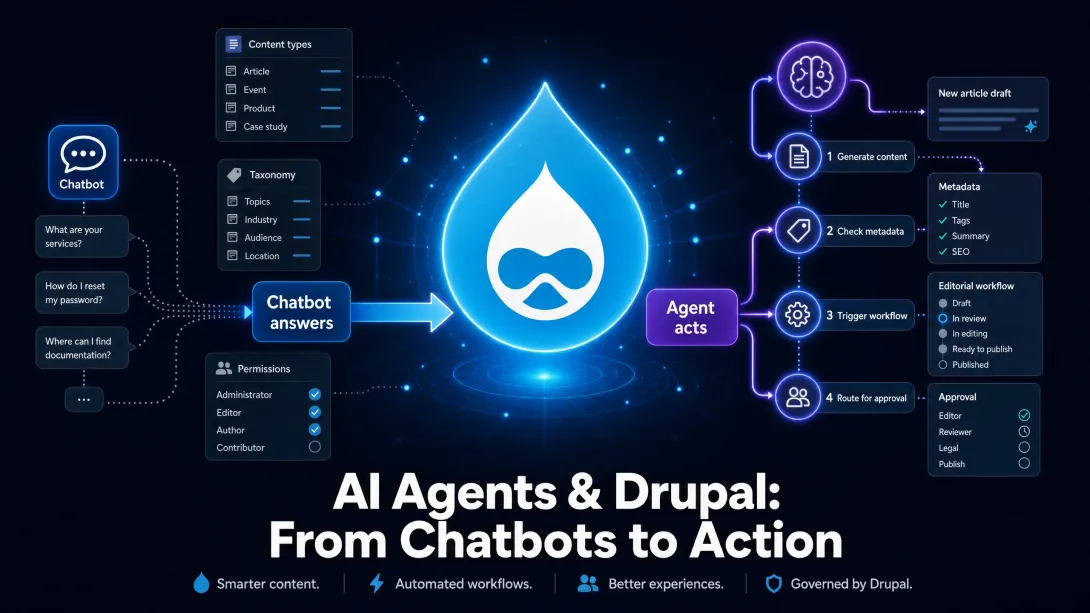
For the past few years, most conversations about AI on websites have centered around chatbots.
A visitor asks a question. The chatbot answers. Maybe it helps them find a page, summarize a policy, explain a product, or point them to a form.
That is useful, but it is only the beginning.
The next stage of AI in Drupal is not just about answering questions. It is about taking action.
AI agents are changing the conversation from “What can the website tell me?” to “What can the website help me do?”
For Drupal, this is a major shift. Drupal already has structured content, users, roles, permissions, workflows, fields, taxonomies, media, moderation states, and integrations. That makes Drupal a natural platform for AI agents because agents need something to act on.
A chatbot talks. An agent does.
That difference is where the future begins.
What Is an AI Agent?
An AI agent is a system that can understand a request, decide what steps are needed, use tools, and take action toward a goal.
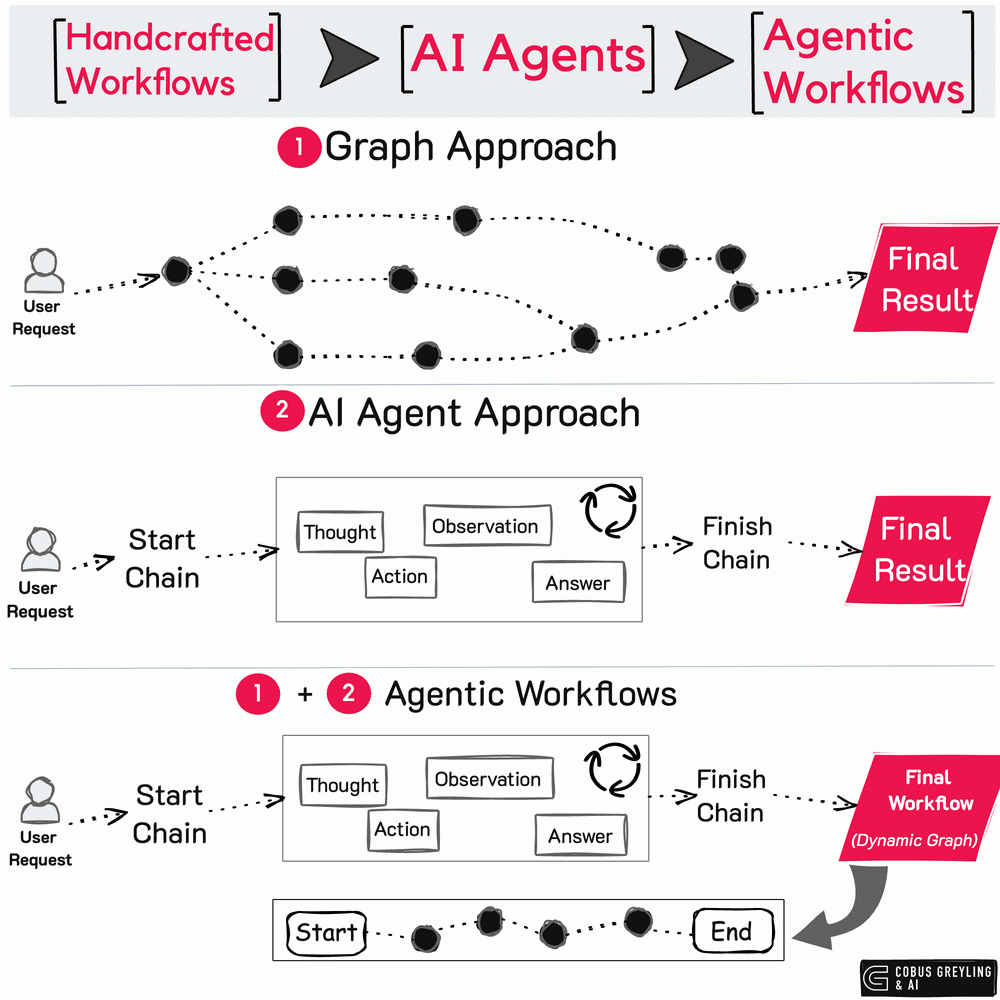
A basic chatbot might answer, “Here is how to create a landing page.”
An AI agent could help create the landing page.
A chatbot might explain, “This article needs a summary, tags, and alt text.”
An AI agent could generate the summary, suggest tags, create alt text, and send the content for editorial review.
A chatbot might say, “You should add an image field to this content type.”
An AI agent could help create or configure that field, depending on the permissions and tools it has been given.
This is why agents matter. They move AI from conversation into workflow.
Why Drupal Is Well Suited for AI Agents
AI agents need structure. Drupal has structure.
Drupal is built around entities, fields, content types, taxonomies, users, permissions, workflows, and configuration. That gives AI agents a meaningful operating environment.
In a simple website builder, an AI agent may only be able to generate text or adjust a page. In Drupal, an agent can potentially work with structured content, metadata, media, editorial states, content relationships, translations, layout systems, and integrations.
That makes Drupal more than a publishing surface. It becomes an action layer.
For example, an AI agent in Drupal could help with:
Creating draft content from a campaign brief
Suggesting taxonomy terms for an article
Generating meta titles and descriptions
Creating image alt text
Checking whether content is ready for publication
Building structured FAQs from long-form content
Creating or modifying content fields
Helping site builders configure content types
Triggering editorial workflows
Preparing content for translation
Connecting Drupal content to CRM or marketing automation systems
This is not just AI as a writing assistant. This is AI as an operational assistant inside the CMS.
From Chatbots to Action
The chatbot era was about conversation.
The agent era is about execution.
A chatbot is useful when the user needs guidance. An agent is useful when the user needs a task completed.
In Drupal, that distinction is powerful because many CMS tasks are repetitive, structured, and rule-based. Editors often need to summarize content, classify content, update fields, generate metadata, review page readiness, prepare social snippets, and route content through approval.
Developers and site builders also repeat many configuration tasks: creating fields, adjusting content types, configuring taxonomy, setting up workflows, and connecting modules.
AI agents can reduce the manual effort around these tasks.
They do not eliminate the need for editors, developers, or governance. They help those people move faster.
AI Agents for Content Editors
Content editors do not need AI agents that feel like science fiction. They need agents that remove everyday friction.
Imagine an editor working on a long article. Instead of manually filling every supporting field, the editor could ask an agent to:
Create a short summary
Suggest SEO metadata
Recommend taxonomy terms
Generate a social media teaser
Check whether the article meets publishing requirements
Create alt text for attached images
Suggest internal links
The agent does not publish the article without review. It prepares the work for the editor.
This is the right model for responsible AI in content management. The agent helps. The human approves.
For busy content teams, this can save meaningful time. The value is not in replacing editors. The value is in reducing the repetitive tasks that keep editors from doing higher-value work.
AI Agents for Site Builders
Site builders are one of Drupal’s most important audiences. They understand structure, content models, fields, views, taxonomies, and workflows, but they may not always want to write custom code.
AI agents can help site builders move faster by turning natural language instructions into configuration assistance.
For example, a site builder could ask:
Create a content type for events.
Add date, location, speaker, and registration link fields.
Create a taxonomy vocabulary for event categories.
Suggest fields for a staff directory.
Explain what fields exist on this content type.
Help create a workflow for draft, review, approved, and published states.
This does not mean every configuration change should happen automatically. It means Drupal can become easier to configure, test, and understand.
For agencies, this is especially valuable. A site builder can move from client requirements to a working prototype faster. Instead of starting from a blank configuration screen, they can collaborate with an AI agent and refine the result.
AI Agents for Developers
Developers may use agents differently.
For developers, agents can help inspect configuration, explain site structure, generate boilerplate, connect APIs, test workflows, and debug complex setups. They can also help create reusable agent tools for clients, editors, or internal teams.
This is where Drupal’s modular architecture becomes important.
AI agents are only as useful as the tools they can safely use. Developers can define those tools, limit what they can do, and connect them to Drupal’s existing APIs and permission systems.
That means developers do not disappear from the workflow. They become the architects of safe automation.
The best Drupal agencies will not simply “turn on AI.” They will design governed AI workflows that match the client’s content model, approval process, security requirements, and business goals.
Why Governance Matters More With Agents
The more AI can do, the more governance matters.
A chatbot that gives a poor answer is a problem. An agent that takes the wrong action can be a much bigger problem.
That is why AI agents in Drupal must be designed with guardrails, permissions, logging, approval steps, and testing.
An agent should not have unlimited access. It should only use the tools it needs. It should respect user roles. It should operate inside defined workflows. It should show what it is doing. It should leave an audit trail. It should ask for confirmation before sensitive actions. It should allow humans to review changes before publication or deployment.
This is where Drupal has an advantage.
Drupal already has a mature permission system. It already supports content moderation. It already supports roles, workflows, revision history, configuration management, and structured content. AI agents can build on these foundations instead of inventing governance from scratch.
Human-in-the-Loop Is the Winning Model
The strongest AI agent workflows are not fully autonomous. They are human-in-the-loop.
For content teams, that means an agent can prepare suggestions, but an editor reviews them.
For site builders, that means an agent can propose configuration, but a responsible user confirms it.
For developers, that means an agent can generate or modify code, but code review and testing still happen.
For agencies, that means AI accelerates delivery without surrendering control.
This matters because Drupal is often used by organizations that cannot afford careless automation: universities, governments, nonprofits, healthcare organizations, associations, financial institutions, and enterprises.
These organizations do not need AI that runs wild. They need AI that works inside their rules.
Examples of Agent Workflows in Drupal
The best way to understand AI agents is to look at practical workflows.
1. Content readiness agent
An editor finishes a draft. The agent checks whether the article has a title, summary, body, image, alt text, taxonomy terms, SEO description, and required approval state. It flags missing items and suggests fixes.
The editor reviews the recommendations and decides what to accept.
2. SEO assistant agent
A content team wants every page to have better search metadata. The agent reviews the page, suggests a meta title, meta description, heading improvements, internal links, and keyword alignment.
The editor keeps control, but the agent removes the blank-page problem.
3. Media accessibility agent
A user uploads images to Drupal media. The agent generates draft alt text, suggests tags, and identifies images that may need better descriptions.
The accessibility reviewer or editor approves the final text.
4. Site-building agent
A site builder wants to create a new content type for programs, services, staff, events, or case studies. The agent suggests fields, taxonomy relationships, display settings, and workflow states.
The site builder reviews the plan, applies it, and tests it.
5. Translation preparation agent
A multilingual team needs to prepare content for translation. The agent checks source content, creates summaries, identifies missing fields, and routes the content toward translation review.
This keeps translation work more organized and consistent.
6. Campaign launch agent
A marketing team needs a campaign landing page, teaser copy, social snippets, and an email summary. The agent helps prepare these assets from one campaign brief, then routes them through review.
This is where AI agents move beyond CMS assistance and into multi-channel digital operations.
Agents Should Be Built Around Real Business Workflows
The danger with AI agents is building impressive demos that do not solve real problems.
A clever chatbot is not enough. A flashy AI action is not enough. The value comes from connecting agents to real workflows that people repeat every week.
For Drupal teams, the best starting point is not “What can AI do?”
The better question is:
What repeated task is slowing down our editors, site builders, developers, or reviewers?
That is where agents should begin. Look for bottlenecks:
Editors spend too much time writing summaries.
Images are missing alt text.
Metadata is inconsistent.
Content is published without required fields.
Taxonomy terms are applied inconsistently.
Site builders repeat the same content type setup.
Agencies rebuild similar demo sites for every sales call.
Marketing teams need campaign assets across multiple channels.
These are practical places where AI agents can help.
Why DrupalForge Matters for AI Agents
AI agents are easier to understand when people can try them.
Reading about an agent is not the same as using one. A content editor needs to see the agent suggest improvements inside a real Drupal form. A site builder needs to watch an agent propose a content model. A developer needs to test how an agent calls tools, respects permissions, and logs actions.
That is where DrupalForge becomes valuable.
DrupalForge makes it easier to launch Drupal environments in the cloud without local setup. Users can work in the browser, open a cloud development environment, use tools like VS Code, Composer, Drush, and phpMyAdmin, and share working demos with others.
For AI agents, this matters because experimentation should be fast.
A team should be able to launch a Drupal AI demo, test an agent workflow, review the results, and decide whether the idea is worth developing further. They should not have to spend the first hour installing local dependencies before they even see the workflow.
DrupalForge gives teams a faster path from idea to working demo.
Why Agencies Should Pay Attention
AI agents can become a serious advantage for Drupal agencies.
Clients do not only want websites. They want better operations. They want faster publishing, fewer bottlenecks, better content quality, stronger governance, improved accessibility, and lower dependence on manual work.
Agents give agencies a way to sell outcomes, not just features.
Instead of saying, “We can build you a Drupal site,” an agency can say:
We can help your editors publish faster.
We can reduce repetitive content work.
We can improve metadata consistency.
We can support accessibility workflows.
We can help your team launch campaign pages faster.
We can build governed AI workflows inside Drupal.
That is a stronger value proposition.
DrupalForge can support this sales motion by making agent-powered demos easier to launch and share. A working demo is more persuasive than a slide deck.
What to Avoid With Drupal AI Agents
AI agents are powerful, but teams should be careful.
Do not give agents broad permissions without a reason.
Do not let agents publish sensitive content without review.
Do not allow agents to modify configuration in production without safeguards.
Do not treat AI output as automatically correct.
Do not skip logging, testing, or approval workflows.
Do not build agents just because they are exciting.
The right approach is controlled experimentation. Start with lower-risk workflows. Keep humans involved. Use permissions carefully. Review output. Test thoroughly. Expand only after the workflow proves useful.
In other words, do not crown an agent king before it has earned the throne.
The Future: Background Agents and Proactive Drupal
Today, many AI workflows begin when a user asks for help. The next stage is background agents.
A background agent does not wait for someone to open a chatbot. It responds to triggers, schedules, content changes, workflow events, or business rules.
For example:
When a new article is saved, an agent checks for missing metadata.
When an image is uploaded, an agent prepares draft alt text.
When a campaign brief is created, an agent drafts supporting content.
When content is stale, an agent suggests updates.
When search data shows poor performance, an agent recommends improvements.
When a page lacks internal links, an agent suggests relevant content.
This is where Drupal can become more proactive.
The CMS does not merely store content. It helps improve the content operation.
From Website Management to Digital Operations
AI agents point to a bigger future for Drupal.
Drupal can become more than a CMS. It can become a digital operations platform.
That means content, workflows, AI assistance, integrations, analytics, personalization, publishing, accessibility, and governance working together.
This is important because organizations do not struggle only with building websites. They struggle with maintaining them, improving them, governing them, and keeping them useful over time.
AI agents can help Drupal teams move from reactive website management to proactive digital operations.
Conclusion: Drupal AI Is Moving From Answers to Action
Chatbots were the first visible stage of AI on websites. They helped users ask questions and get answers.
AI agents are the next stage.
They can help Drupal users take action: create content, improve metadata, prepare translations, configure fields, review readiness, support accessibility, trigger workflows, and connect digital operations.
Drupal is especially well suited for this future because it already has the structure agents need: content types, fields, taxonomies, users, permissions, workflows, moderation, media, configuration, and integrations.
But the winning model will not be uncontrolled automation. The winning model will be governed AI: agents with permissions, guardrails, logs, testing, and human review.
DrupalForge makes this future easier to explore by giving teams cloud-based Drupal environments they can launch, test, share, and learn from without local setup.
The future of Drupal AI is not just a chatbot in the corner of the website.
The future is AI that helps Drupal teams take action.
Try DrupalForge today and explore how AI agents can turn Drupal from a content platform into an action platform.