DrupalForge for Healthcare: Faster Patient-Centered Websites Without Starting From Scratch
Healthcare websites carry a heavy responsibility.
They are not just marketing websites. They help patients find care, understand services, locate providers, register for events, read important health information, and decide whether an organization feels trustworthy enough to contact.
That first digital impression matters.
A patient may visit a healthcare website while anxious, tired, confused, or urgently looking for help. They may be searching from a phone. They may need accessible content. They may need information in plain language. They may need to find a provider, check office hours, understand accepted insurance, or locate the nearest clinic.
For healthcare organizations, the website must do more than look polished. It must be clear, accessible, secure-minded, easy to update, and built around patient needs.
That is why the DrupalForge Healthcare template is important.
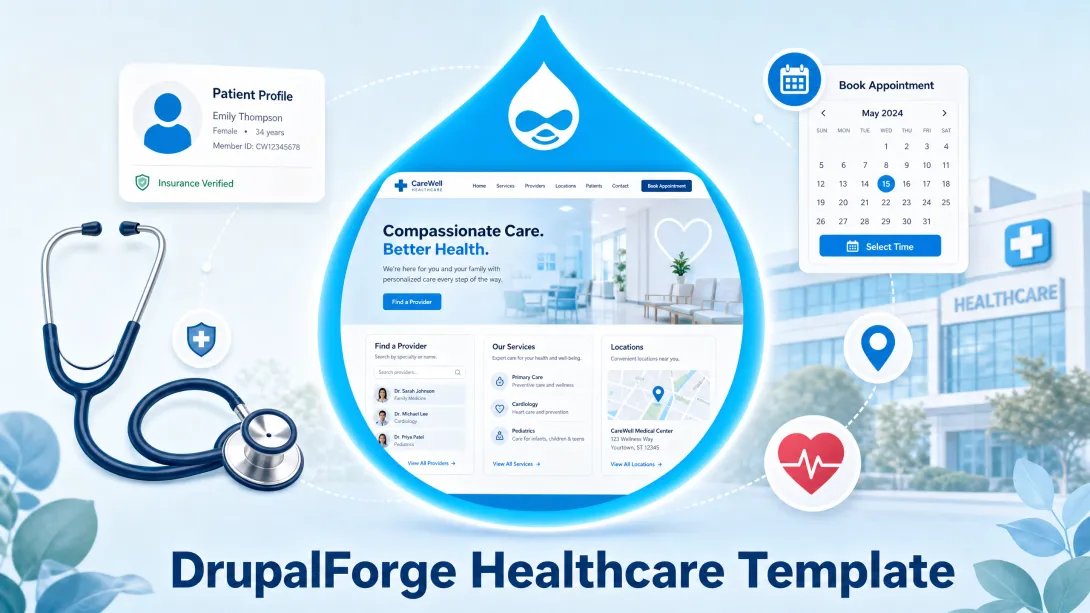
It gives clinics, group practices, hospital networks, and healthcare-focused organizations a faster way to launch a professional Drupal-based digital foundation without starting from a blank screen.
Healthcare Websites Need Trust From the First Click
Trust is the currency of healthcare.
Patients want to know that they are in the right place, that the organization is credible, and that they can find what they need quickly. A confusing website creates doubt. A slow or outdated website creates friction. A poorly organized site can make even a strong healthcare organization feel difficult to access.
A patient-centered healthcare website should answer common questions quickly:
What services are available?
Where are the locations?
Which providers are available?
What specialties are offered?
Are new patients being accepted?
What languages are spoken?
What insurance is accepted?
How do I book an appointment?
What are the office hours?
Is the location accessible?
The DrupalForge Healthcare template is designed around these real patient needs. It gives healthcare teams a practical starting point with content structures, layouts, and design patterns built specifically for medical websites.
A Healthcare Template Built for Drupal CMS
The Healthcare template is an open-source Drupal Site Template created by Kanopi Studios. It is built for Drupal CMS 2.x and includes pre-configured content types, realistic default content, and a medical-focused theme called Diagnosis.
This matters because healthcare teams should not have to begin every website project by reinventing the same foundation.
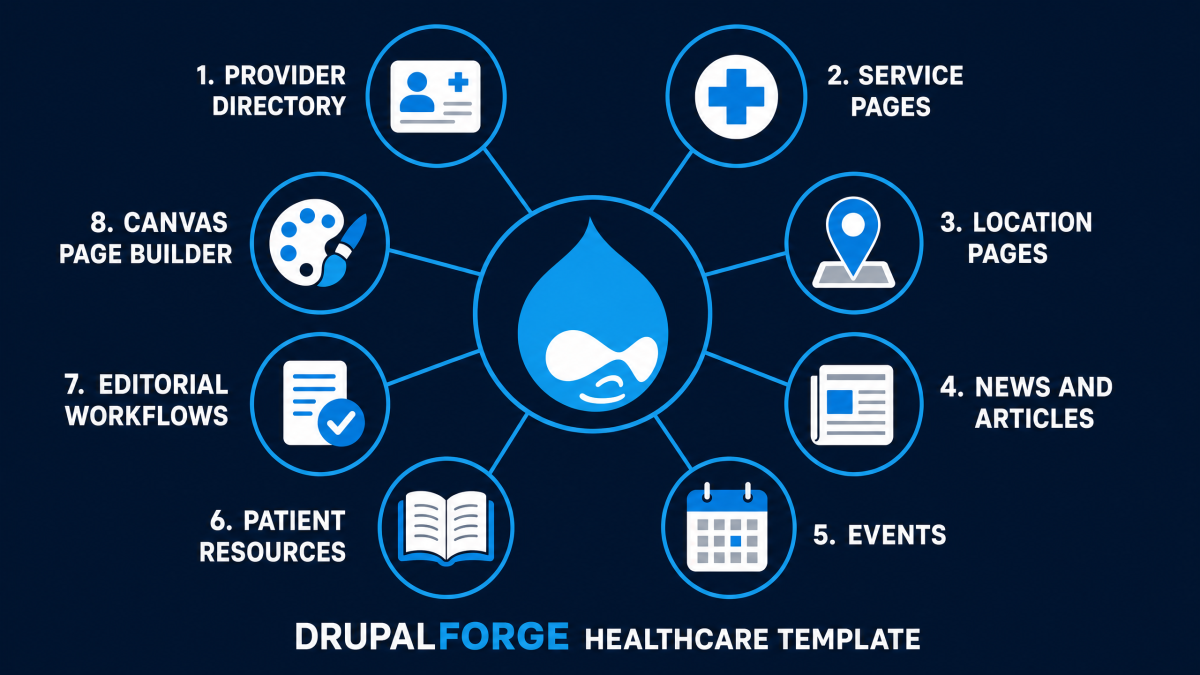
Most healthcare websites need predictable building blocks:
Provider profiles
Service pages
Location pages
News and articles
Events
Patient resources
Internal resources
Navigation structures
Accessible page layouts
The Healthcare template gives teams these foundations early, so they can spend more time refining the patient experience and less time assembling basic site structure.
Why DrupalForge Makes the Healthcare Template Easier to Try
A template is most valuable when people can experience it.
Reading about a healthcare template is useful. Seeing it live is better. Clicking through provider pages, testing service pages, exploring location content, opening the admin interface, and seeing how the content model works is what turns an idea into a real evaluation.
That is where DrupalForge helps.
DrupalForge lets users launch Drupal templates in the cloud, without local setup. Instead of installing tools locally, users can open a working Drupal environment, explore the site, use a Cloud Dev Environment, access browser-based VS Code, run Composer and Drush, inspect the database with phpMyAdmin, and collaborate with others.
For healthcare teams, this changes the evaluation process.
A clinic, agency, or hospital network can launch the Healthcare template, review the patient-facing experience, inspect the content structure, and decide what needs to be customized before committing to a full build.
That is a much better first step than starting with a blank project plan.
Designed Around Patient Discovery
One of the strongest parts of the Healthcare template is its focus on discovery.
Patients rarely arrive at a healthcare website with only one question. They often need to connect multiple pieces of information: the right provider, the right specialty, the nearest location, accepted insurance, available services, office hours, and appointment options.
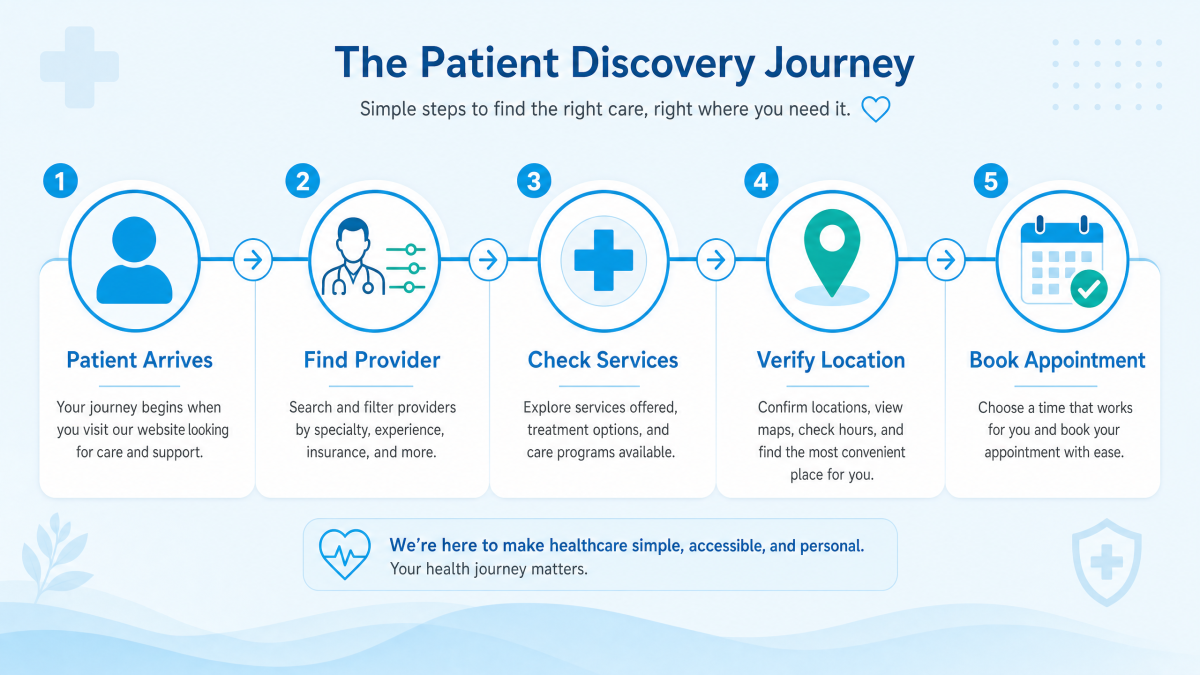
The Healthcare template supports this journey with patient-centered content patterns.
Provider directory features can help visitors filter by specialty, location, languages spoken, and whether providers are accepting new patients. Service pages can explain what care is available, connect services to related providers, and guide patients toward appointment booking. Location pages can include practical details such as maps, office hours, parking, transit information, and accessibility details.
This is exactly the kind of structure healthcare websites need.
Patients should not have to hunt for basic information. The site should guide them.
Built With Accessibility in Mind
Accessibility is not optional for healthcare.
Healthcare websites serve people of all ages, abilities, devices, and circumstances. A patient may rely on a screen reader. A visitor may have low vision. Someone may be navigating the site with a keyboard. A caregiver may be using a mobile phone in a stressful moment.
The Healthcare template is built with WCAG 2.2 Level AA standards in mind, giving teams a stronger accessibility starting point than a generic website template.
This does not remove the need for accessibility review, testing, and content discipline. Accessibility is not a one-time checkbox. Every new page, image, form, heading, link, and document still needs care.
But starting from a healthcare-focused Drupal template gives teams a better foundation.
The right foundation matters. It is easier to preserve accessibility from the beginning than to retrofit it after a site has already grown.
Security-Minded Workflows for Healthcare Teams
Healthcare organizations must treat security and privacy seriously.
A website template alone does not make an organization HIPAA compliant. Compliance depends on hosting, policies, access controls, data flows, staff training, legal review, security practices, vendor agreements, and whether the website handles protected health information.
That said, a healthcare website should still begin with security-minded patterns.
The DrupalForge Healthcare template includes features such as secure form handling, CAPTCHA protection, cookie consent management, and controlled access to internal resources. These are useful building blocks for healthcare organizations that need stronger governance around public-facing and internal content.
The strategic point is simple: do not treat security as a decoration added at the end.
Healthcare websites should be planned from the beginning with privacy, access control, and operational responsibility in mind.
Editorial Workflows Help Protect Quality
Healthcare content should not be published carelessly.
A service description, provider profile, patient resource, clinic update, or event announcement may need review before it goes live. The wrong wording can create confusion. Outdated information can frustrate patients. Missing details can create unnecessary phone calls. Inaccurate content can damage trust.
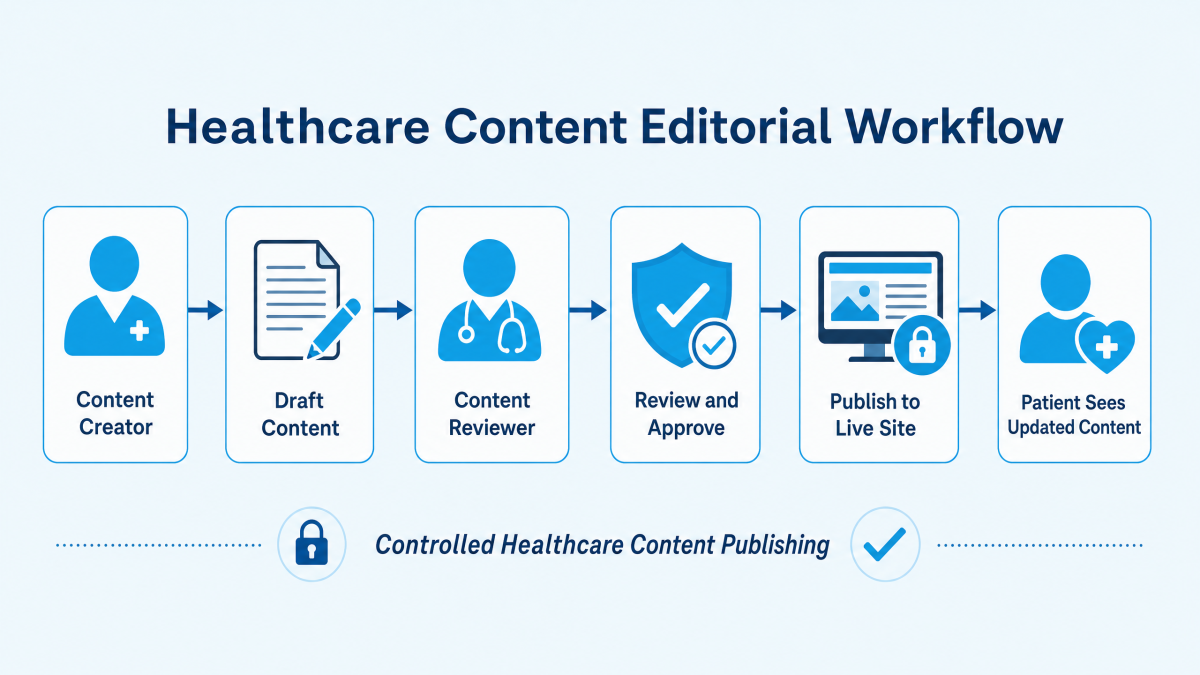
Drupal’s editorial workflow capabilities are a major advantage for healthcare organizations.
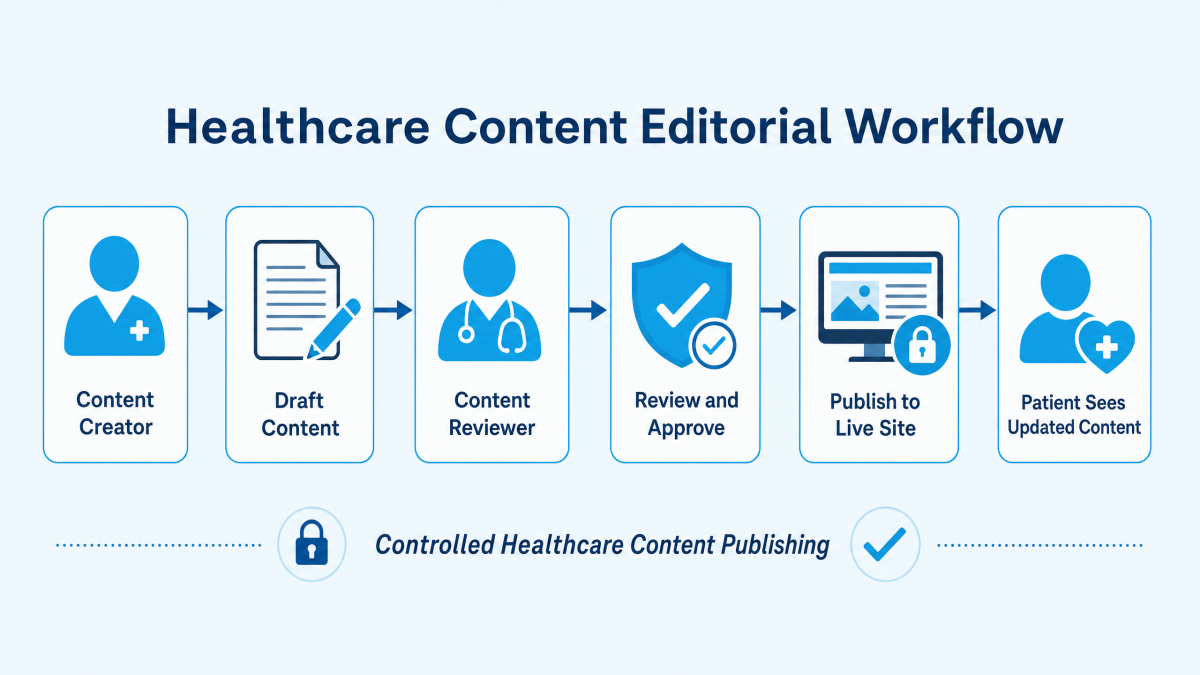
The Healthcare template supports content review and approval workflows so teams can manage updates more carefully. Editors can draft, review, revise, and publish content through a controlled process instead of relying on informal updates.
This matters for organizations with multiple departments, locations, service lines, and content owners.
Good governance is not bureaucracy. It is protection.
Canvas Page Building Gives Teams More Independence
Healthcare teams often need to update pages quickly.
A clinic may need to promote a vaccination event. A hospital may need to publish a new service page. A communications team may need to build a campaign landing page. A department may need to update provider information or add patient resources.
Waiting on developers for every routine page update slows the organization down.
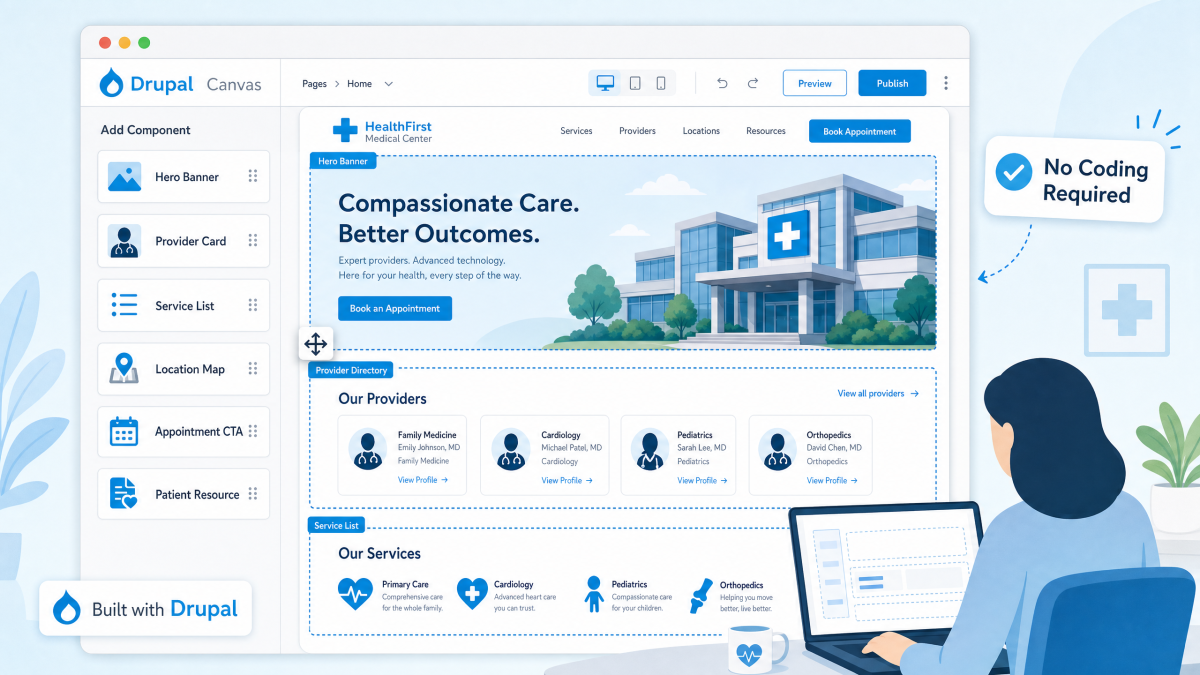
The Healthcare template supports the Drupal Canvas page builder, giving teams a more visual way to create and update pages without coding.
This is especially useful when paired with a strong component system. Developers and designers can define approved components, while editors and site builders assemble pages inside clear guardrails.
That creates a better balance:
Editors move faster.
Developers spend less time on routine layout changes.
Design consistency is easier to protect.
Healthcare teams can respond faster to real-world needs.
For healthcare organizations, speed matters. But uncontrolled speed is dangerous. Canvas gives teams speed inside structure.
Why Drupal Is a Strong Fit for Healthcare
Drupal has long been a strong fit for healthcare because healthcare websites often require more than simple page publishing.
Healthcare organizations may need:
Complex content models
Provider directories
Location-based search
Multilingual content
Editorial workflows
Role-based permissions
Reusable components
Accessibility support
Integrations with other systems
Scalable architecture
Strong governance
Drupal is built for this kind of complexity.
The Healthcare template makes those strengths more approachable by packaging a healthcare-focused starting point inside Drupal CMS.
DrupalForge makes that starting point easier to try.
From Demo to Real Healthcare Project
A healthcare website project should not begin with guesswork.
Before an organization invests in a full website build, it should be able to see a working model. Stakeholders should be able to click through the site, review provider profiles, test service pages, inspect locations, understand content workflows, and see how the template supports patient needs.
DrupalForge makes that possible.
A team can launch the Healthcare template as a live demo, share it with stakeholders, customize it in the cloud, and use it as the starting point for deeper planning.
This creates a stronger project discovery process.
Instead of asking stakeholders to imagine what the site might become, DrupalForge lets them respond to something real.
Why Agencies Should Pay Attention
Agencies serving healthcare organizations need to show value quickly.
Healthcare clients often have many stakeholders: executives, marketing teams, compliance teams, clinical departments, IT teams, accessibility reviewers, and content owners. Static mockups and long proposals can only go so far.
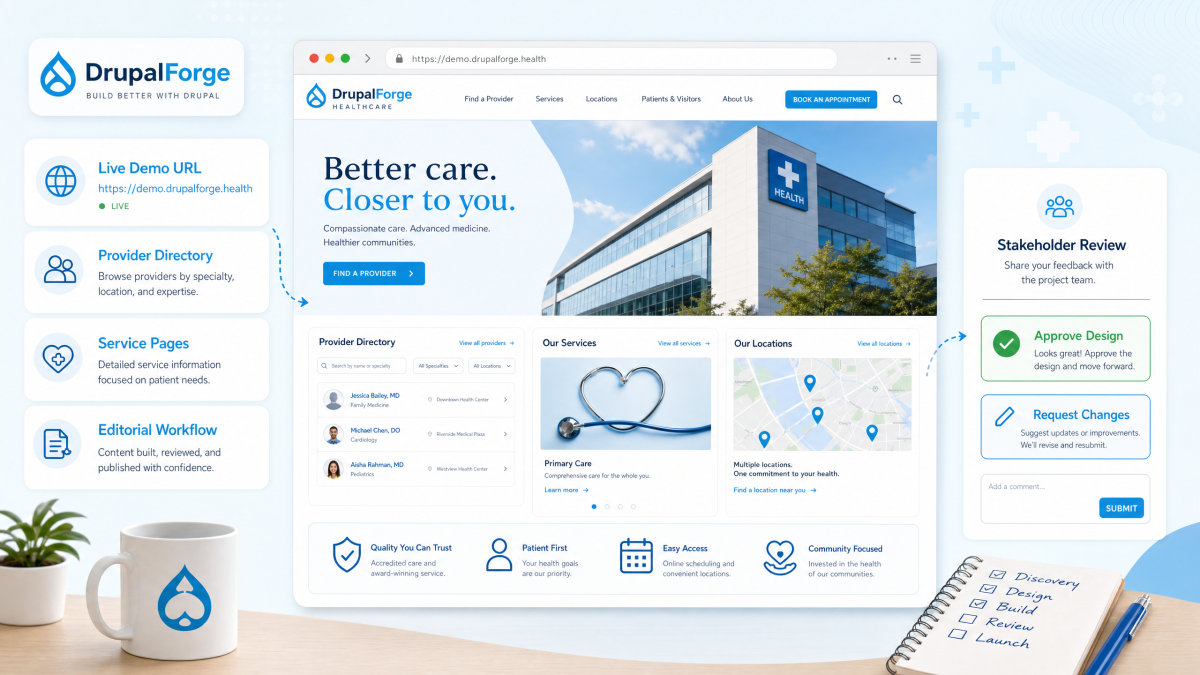
A live DrupalForge demo gives agencies a stronger way to lead the conversation.
An agency can launch the Healthcare template, show the provider directory, walk through service pages, demonstrate location pages, review editorial workflows, and explain how the template can be customized for the client’s brand and operational needs.
This shifts the sales conversation from abstract to concrete.
Clients do not have to imagine the value. They can see it, click it, and respond to it.
Why Smaller Clinics Should Care
Large hospital networks are not the only organizations that need better healthcare websites.
Small clinics, group practices, community health organizations, and regional providers also need professional digital experiences. But they may not have the budget or timeline for a completely custom build from scratch.
The Healthcare template gives these organizations a practical starting point.
They can begin with a structure designed for healthcare instead of a generic business template. They can show services, providers, locations, events, news, and resources in a more patient-centered way.
For smaller organizations, this can reduce the gap between what they need and what they can afford to build.
Why Larger Health Systems Should Care
Larger health systems face a different challenge: scale and consistency.
They may manage many departments, locations, service lines, providers, campaigns, and content owners. Without a strong structure, the website can become inconsistent and difficult to govern.
Drupal’s structured content model and permissions are valuable here.
The Healthcare template provides a useful starting point for consistent healthcare content patterns. Larger organizations can adapt the template, expand it, and integrate it into more complex digital strategies.
The goal is not to freeze every healthcare organization into the same design. The goal is to start from a strong pattern and customize intelligently.
Healthcare Content Should Be Easy to Maintain
A healthcare website is never finished.
Providers change. Office hours change. Services change. Insurance information changes. Event details change. Locations open or close. Patient resources need updates. News and announcements need to be published.
If the website is difficult to maintain, content becomes outdated.
The Healthcare template helps by organizing content into useful structures. Provider content can be managed as provider content. Location content can be managed as location content. Service content can be managed as service content.
This is better than treating every page as a one-off design.
Structured content makes healthcare websites easier to maintain, reuse, search, and govern over time.
DrupalForge Helps Teams Experiment Safely
Healthcare organizations should be careful about production systems. But experimentation still matters.
Teams need a place to test ideas, review templates, try content structures, evaluate design patterns, and train users before making decisions.
DrupalForge gives teams a cloud-based environment for that kind of experimentation.
They can launch a temporary demo, explore the Healthcare template, invite collaborators, test page-building workflows, and decide what should be customized before moving toward a production implementation.
This is a smarter way to plan.
Do not gamble the project on assumptions. Test the experience first.
What Healthcare Teams Should Customize
The Healthcare template is a starting point, not the final strategy.
Every healthcare organization should customize the template around its real patients, services, locations, policies, brand, and compliance requirements.
Important areas to review include:
Brand identity and visual design
Provider profile requirements
Service taxonomy and navigation
Appointment booking links
Insurance and billing information
Language support
Accessibility review
Form handling and privacy requirements
Patient resource structure
Editorial approval workflows
Hosting and security architecture
Integration needs
This is where a strong Drupal agency or internal web team adds value.
The template accelerates the starting point. The strategy still belongs to the organization.
A Better Starting Point for Healthcare Websites
The old way to build a healthcare website often started with a blank canvas, a long requirements document, and months of design and development before stakeholders could touch anything real.
DrupalForge offers a better first step.
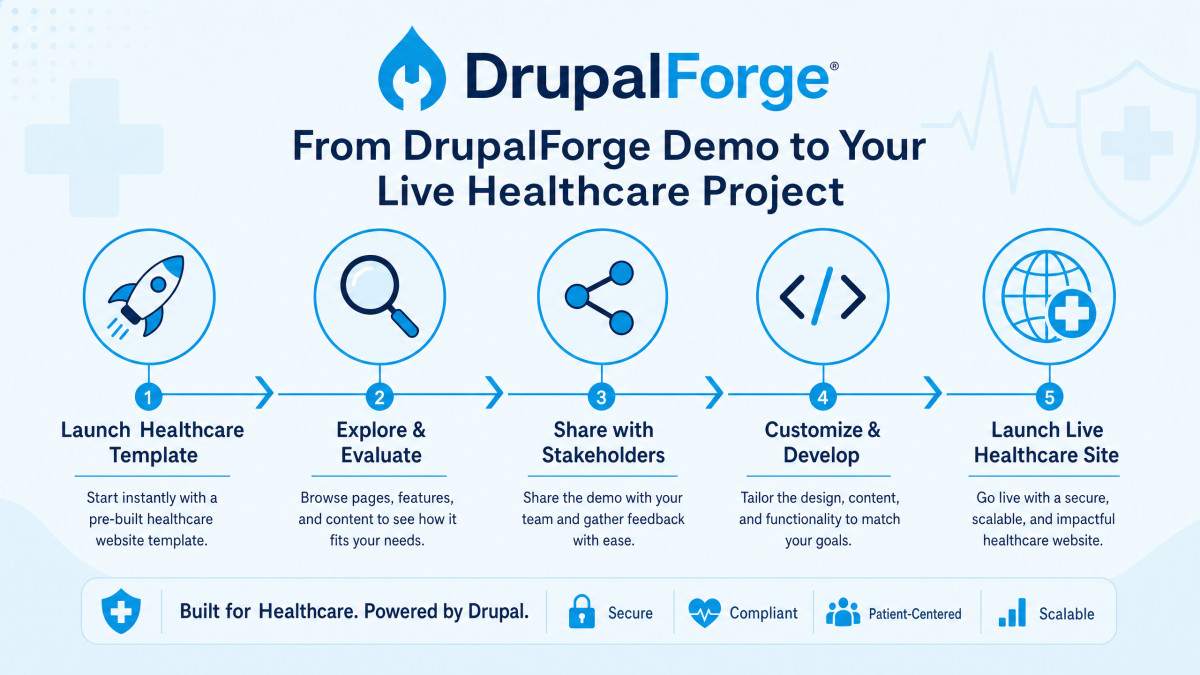
Launch the Healthcare template. Explore the patient experience. Review the provider directory. Test service pages. Inspect location content. Open the development environment. Share the demo with stakeholders. Then decide what to customize.
This reduces risk because the team can make decisions based on a working model.
In healthcare, clarity is power. The organization that sees the field clearly can move with confidence.
Conclusion: DrupalForge Helps Healthcare Teams Move Faster Without Losing Control
Healthcare websites must serve patients, support trust, meet accessibility expectations, protect sensitive workflows, and stay easy to update over time.
That is too important to build from a generic template.
The DrupalForge Healthcare template gives healthcare organizations a stronger starting point: patient-centered design, provider discovery, service pages, location pages, editorial workflows, Canvas page building, accessibility-minded structure, and Drupal’s flexible content foundation.
DrupalForge makes that template easier to launch, explore, customize, and share in the cloud.
For clinics, group practices, hospital networks, healthcare agencies, and mission-driven health organizations, this means a faster path from idea to working Drupal experience.
Not a shortcut around strategy.
A shortcut to the right conversation.
Try the Healthcare template on DrupalForge and see how quickly your team can move from healthcare website idea to working Drupal demo.