DrupalForge: Making Drupal Demos, Development, and Training Faster, Easier, and More Open
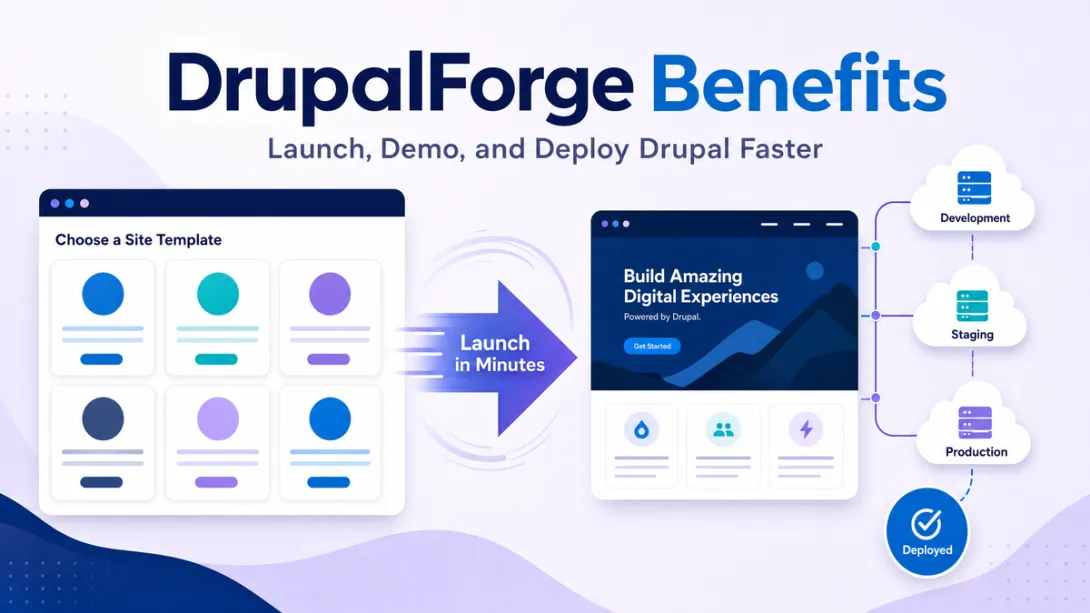
Drupal has long been known for its flexibility, extensibility, and suitability for complex digital experiences. Yet for many developers, agencies, educators, and organizations, the first step can still feel unnecessarily heavy: setting up a local environment, installing the right dependencies, configuring modules, preparing demo content, and making sure everyone on the team can reproduce the same result. DrupalForge addresses that friction by offering a browser-based platform for launching Drupal sites quickly, experimenting safely, and sharing working environments with others.
At its core, DrupalForge is designed around a simple promise: demo, develop, and deploy without the usual setup barriers. The platform emphasizes fast site launches, pre-built templates, and open collaboration so that users can focus less on infrastructure and more on building, teaching, testing, and presenting Drupal-based solutions.
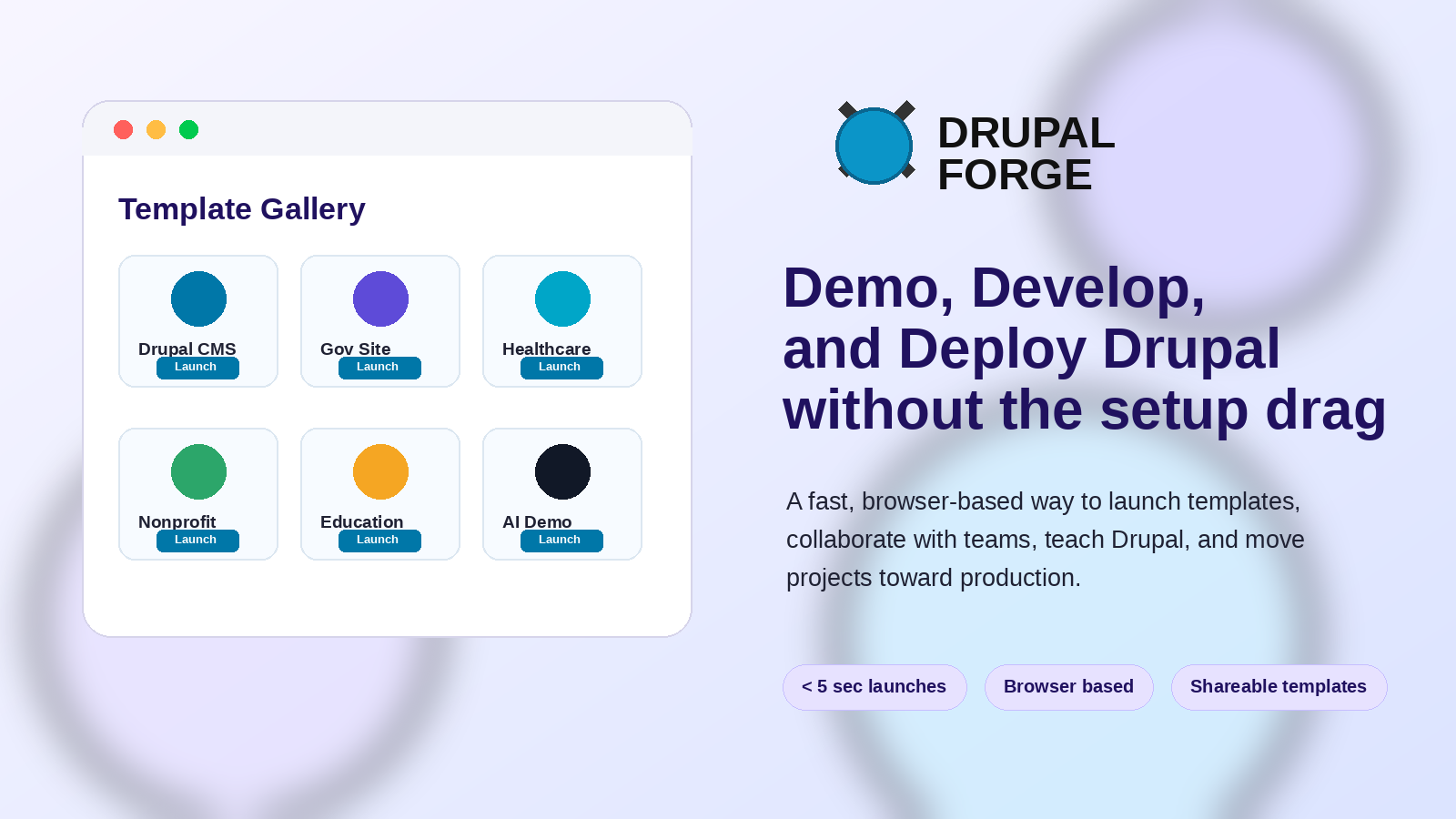
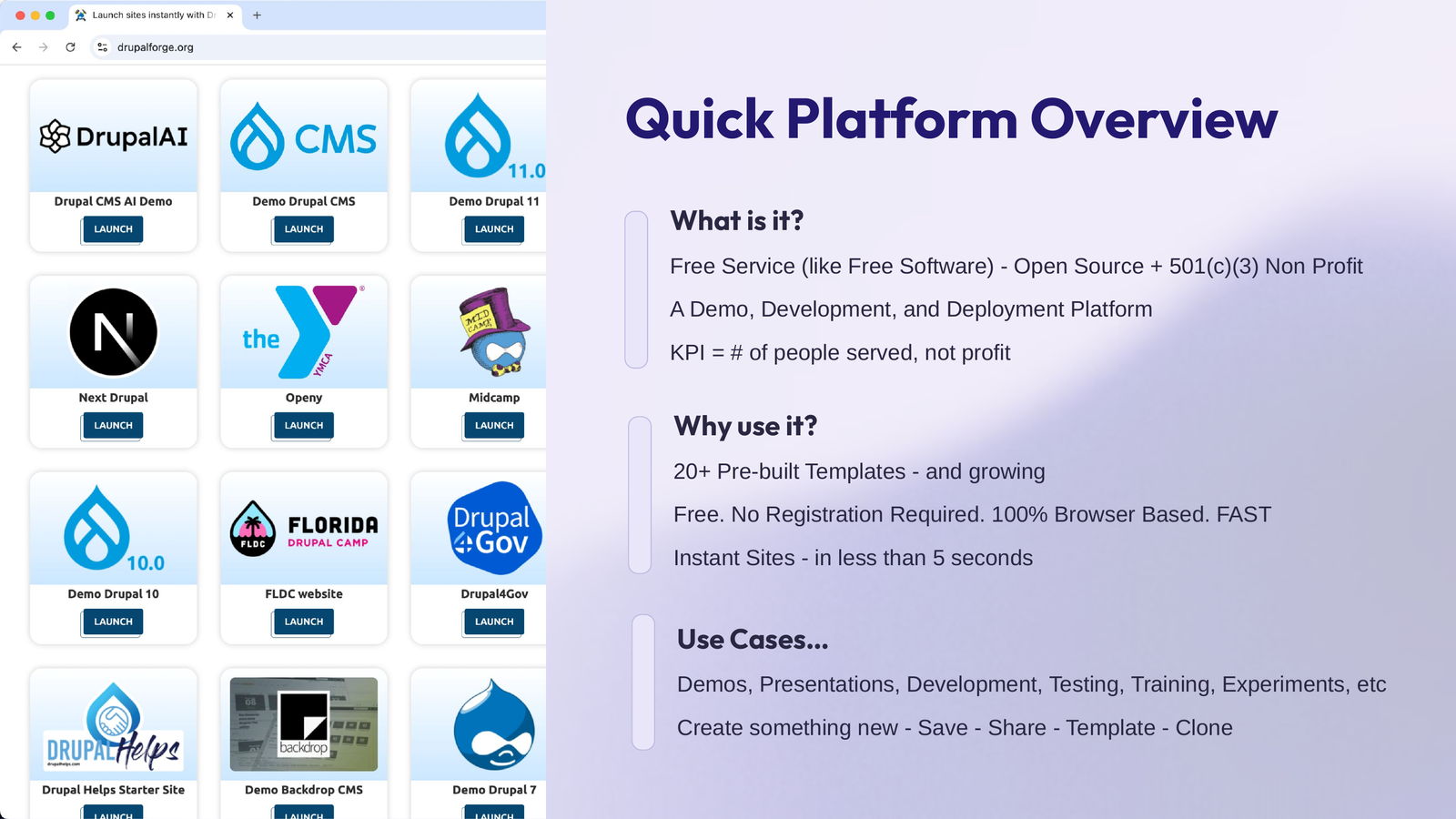
DrupalForge positions itself as an open platform where the key measure of success is not profit, but the number of people served. The presentation describes it as a free service, aligned with open-source values and organized around community benefit.
What Is DrupalForge?
DrupalForge is a demo, development, and deployment platform for Drupal. It provides ready-to-use environments that can be launched directly from the browser, allowing users to start from templates rather than beginning every project with a manual installation process. The DrupalForge website describes the experience as “Easy, Fast, and Free,” with the ability to launch sites in under five seconds.
DrupalForge Capability | What It Means in Practice |
Instant site creation | Users can launch a working Drupal environment in seconds rather than spending time on setup and configuration. |
Browser-based access | Teams, students, clients, and stakeholders can access environments without installing local tooling. |
Pre-built templates | Users can begin from reusable examples for Drupal core, government, education, healthcare, nonprofit, agency, AI, and event use cases. |
Shareable environments | Projects can be saved, shared, cloned, and reused for demos, training, contribution sprints, and experimentation. |
Deployment freedom | DrupalForge is presented as a starting point rather than a lock-in platform, with users able to move production sites to their preferred hosting provider. |
This combination makes DrupalForge especially valuable for situations where speed, consistency, and accessibility matter. A sales demo, training class, conference workshop, proof of concept, or module experiment can begin from a working site instead of a blank command line.
Why DrupalForge Matters
The most immediate benefit of DrupalForge is that it reduces the friction of getting started. Traditional Drupal development often requires local environment setup, server configuration, dependency management, and troubleshooting before meaningful work begins. DrupalForge removes much of that early complexity by giving users a functioning environment from the start.
The presentation frames the platform as a response to several common pain points: no more struggling with local development environments, no more confusion about installation, no more hardware constraints, and fewer frustrations for new users trying to understand how Drupal works.
Common Challenge | How DrupalForge Helps |
Local setup complexity | A browser-based environment reduces dependency on local machine configuration. |
Inconsistent training environments | Every participant can begin from the same template and configuration. |
Slow demo preparation | Agencies and presenters can launch complete examples quickly. |
Risky experimentation | Developers can test ideas without affecting production systems. |
Client or stakeholder review delays | Shareable environments make it easier to gather feedback earlier. |
This is especially important for Drupal adoption. When the first experience is fast, visual, and hands-on, Drupal becomes easier to evaluate and easier to teach. Instead of explaining what Drupal can do in abstract terms, teams can show a live environment immediately.
Who Benefits from DrupalForge?
DrupalForge is useful because it solves different problems for different groups while keeping the core experience consistent. Developers get faster experimentation, agencies get stronger demos, trainers get consistent classrooms, and organizations get a safer way to evaluate Drupal before making larger decisions.
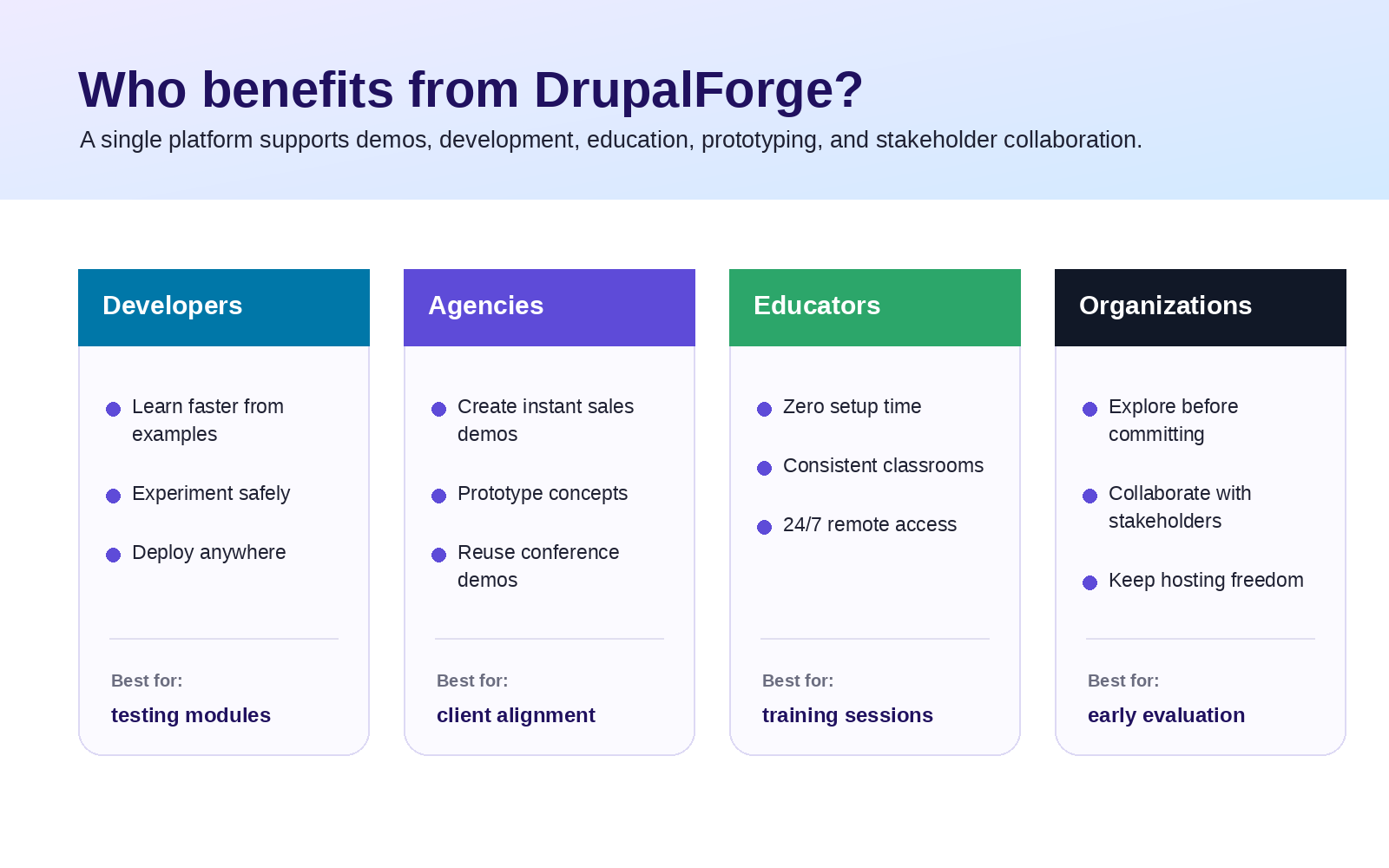
Benefits for Developers
For developers, DrupalForge functions as a practical learning and experimentation layer. It provides instant access to working examples, which can shorten the time between curiosity and understanding. Instead of installing a module locally just to see whether it fits a use case, a developer can start from a relevant template and explore the behavior in a working Drupal site.
The presentation identifies six major developer benefits: faster learning, lower development costs, better collaboration, safer experimentation, open customization, and deployment flexibility. These benefits are especially useful for developers who need to test Drupal modules, recipes, integrations, front-end approaches, or site architectures without repeatedly rebuilding environments from scratch.
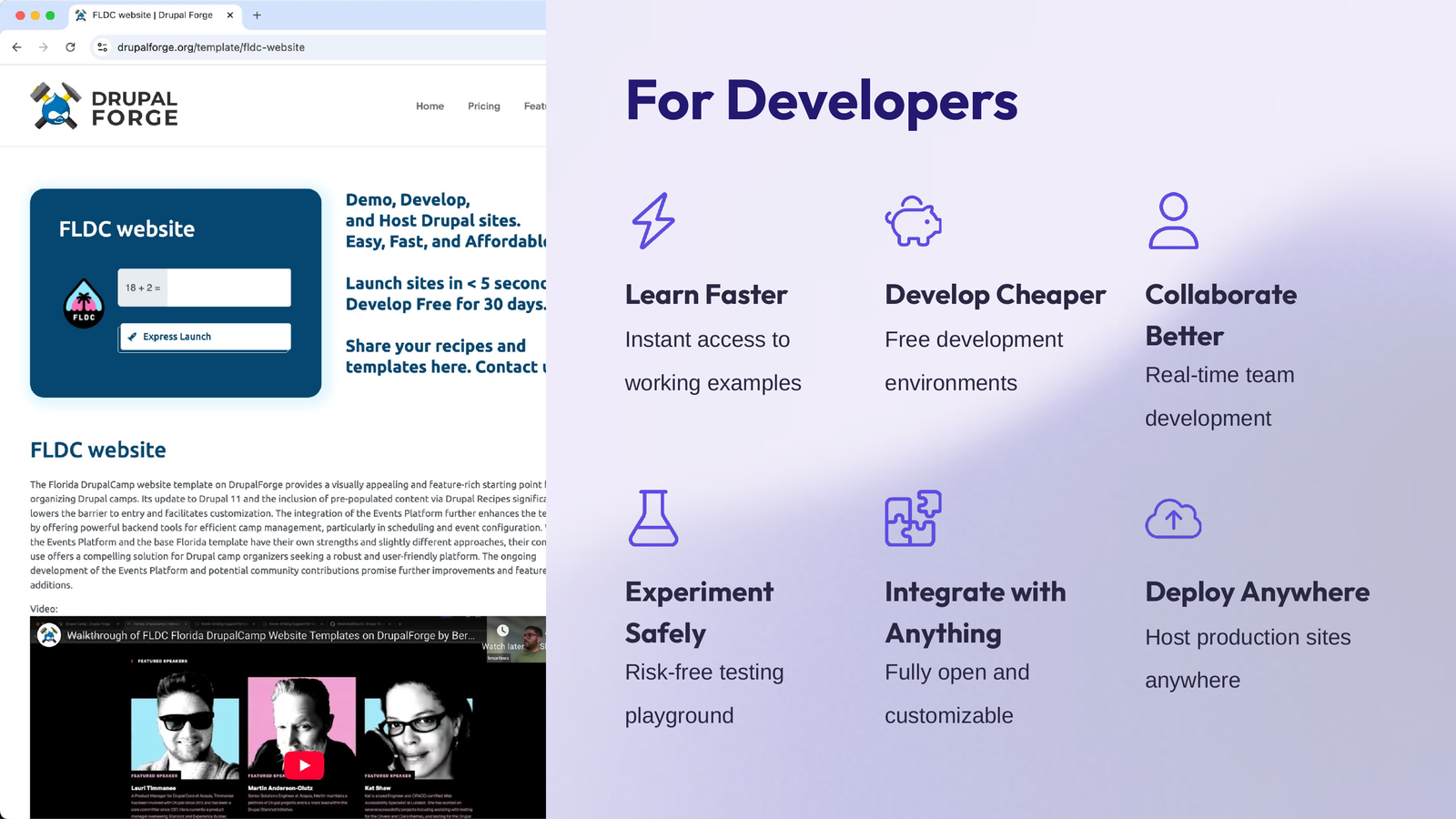
Developer Benefit | Practical Impact |
Learn faster | Working examples help developers understand features, modules, and architectures through direct experience. |
Develop cheaper | Free development environments can reduce the need for paid infrastructure during early exploration. |
Collaborate better | Shareable environments allow teams to work from the same baseline. |
Experiment safely | Developers can test ideas without risking production or long-lived development environments. |
Integrate with anything | The platform’s open nature supports customization and integration-focused workflows. |
Deploy anywhere | Users retain the freedom to host production sites on platforms such as AWS, Pantheon, Acquia, or internal infrastructure. |
This makes DrupalForge useful not only for beginners, but also for experienced developers who want a faster way to validate ideas. The value is not simply that a site launches quickly; it is that the launch becomes a repeatable starting point for learning, testing, and sharing.
Benefits for Agencies and Freelancers
Agencies and freelancers often need to communicate value before a full build begins. Static mockups and slide decks can be helpful, but they rarely create the same confidence as a functioning demo. DrupalForge supports instant sales demos, allowing agencies to show clients a real site experience rather than describing one.
The platform is also useful for conferences, camps, and presentations. Speakers can prepare complete environments in advance, demonstrate them live, and give attendees a way to continue exploring after the session. This helps transform a presentation from a one-time event into a reusable learning asset.
Agency or Freelancer Use Case | DrupalForge Advantage |
Sales demonstrations | Agencies can show live, functional Drupal examples quickly. |
Client prototyping | Teams can validate concepts before committing to a full implementation. |
Module and recipe testing | Developers can compare approaches in isolated environments. |
Conference presentations | Speakers can prepare consistent demos that attendees can access afterward. |
Training and onboarding | Agencies can set up everything beforehand so participants begin productively. |
For service providers, this can shorten the path from idea to stakeholder alignment. A client does not need to imagine how a Drupal-based solution might work; they can interact with one.
Benefits for Trainers and Educators
Drupal training is most effective when learners can start practicing immediately. However, training sessions are often slowed down by setup issues: different operating systems, inconsistent local environments, missing dependencies, or network restrictions. DrupalForge helps solve this by providing consistent, browser-accessible environments for every participant.
The presentation highlights four education-focused benefits: zero setup time, 100% consistency, 24/7 availability, and zero infrastructure cost. These benefits are particularly relevant for universities, bootcamps, professional workshops, remote courses, and hybrid learning programs.
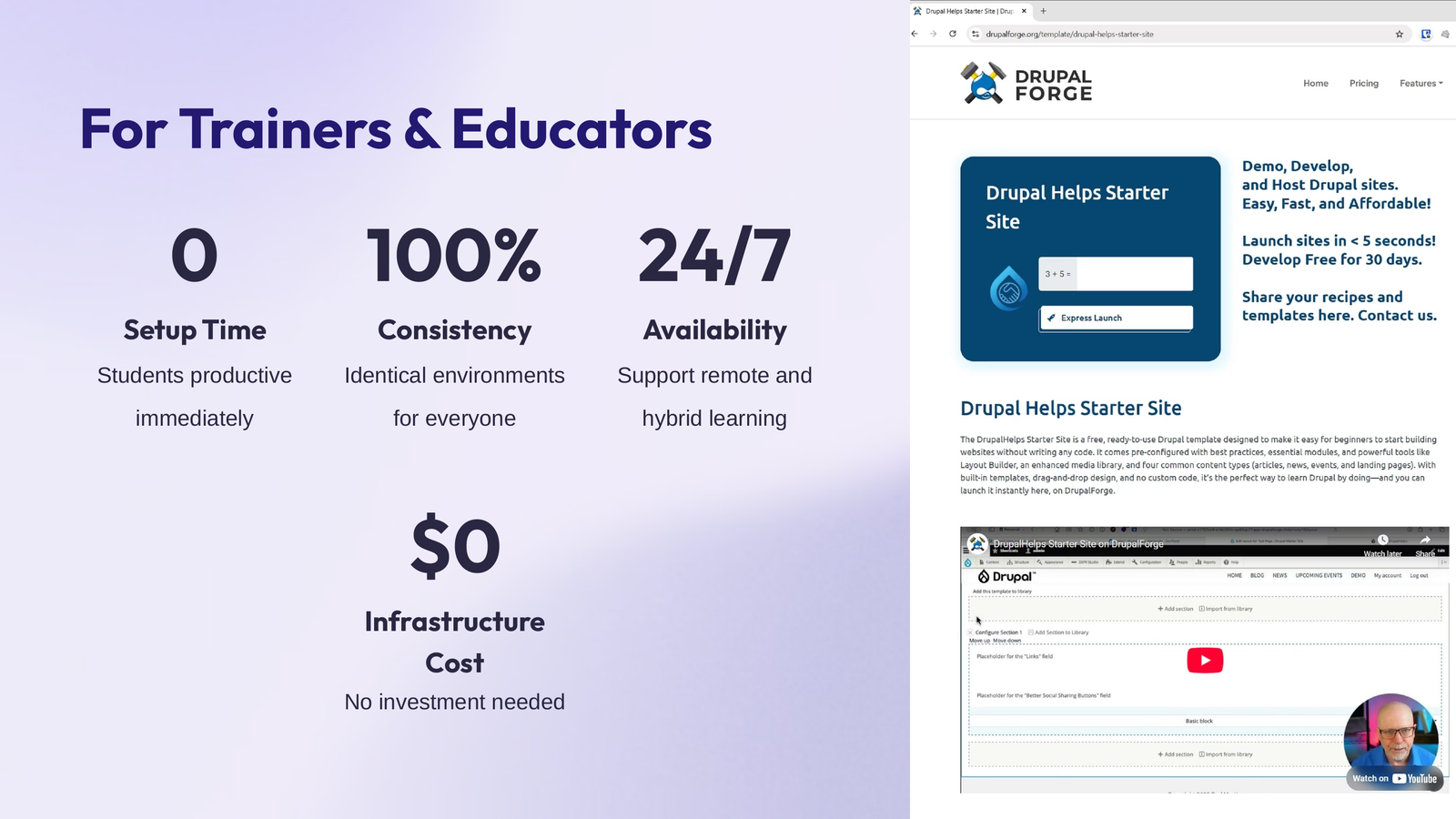
Training Need | DrupalForge Benefit |
Immediate productivity | Students can begin learning Drupal concepts without spending the first session on setup. |
Consistency across learners | Every participant works from the same environment and template. |
Remote and hybrid support | Browser access supports distributed classrooms and asynchronous learning. |
Lower infrastructure burden | Trainers do not need to provision individual servers or require specialized local hardware. |
For educators, the result is more time spent teaching Drupal and less time troubleshooting machines. For learners, the experience becomes less intimidating and more hands-on from the beginning.
Benefits for End Users and Organizations
DrupalForge is not only for technical users. It also creates value for organizations that want to explore Drupal before committing to a full production path. End users can build on DrupalForge, collaborate with teams and stakeholders, and later deploy to their preferred hosting environment when ready.
This matters because many organizations need freedom of choice. A public agency, nonprofit, healthcare organization, or enterprise may have specific hosting, governance, compliance, or procurement requirements. DrupalForge supports exploration and development without forcing the final production site to remain on a single platform.
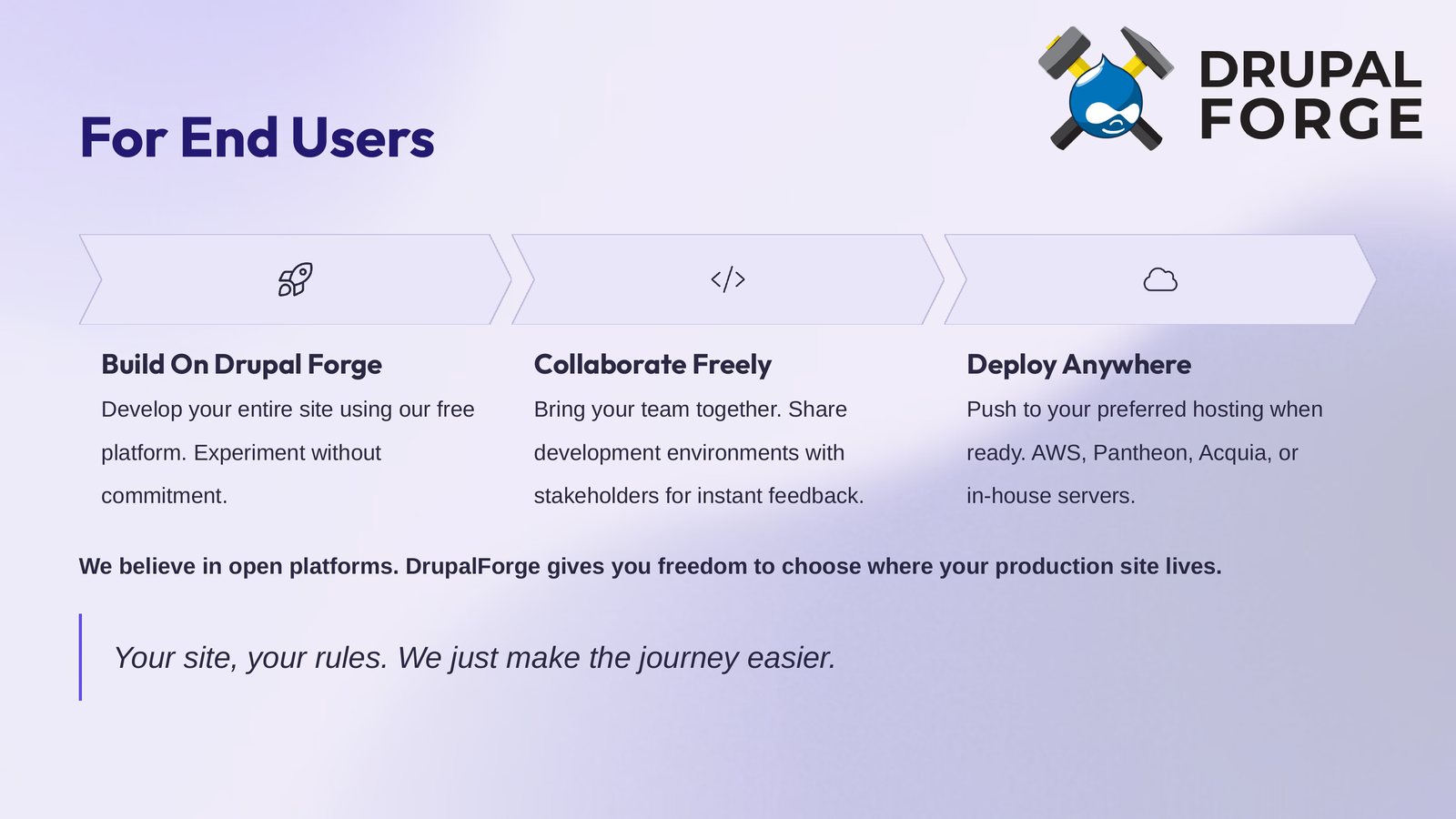
The presentation summarizes this philosophy clearly: “Your site, your rules. We just make the journey easier.”
Organization Type | Potential DrupalForge Value |
Government agencies | Quickly evaluate public-sector templates and structured content approaches. |
Higher education | Explore university-focused templates and support training or departmental prototyping. |
Healthcare organizations | Test patient-centered site structures, provider directories, and service listing concepts. |
Nonprofits | Launch prototypes for donation, community, project, and people-profile experiences. |
Enterprises | Validate Drupal architectures before investing in full implementation. |
The broader benefit is confidence. Teams can see, test, and refine ideas before making larger technical or budgetary decisions.
The Role of Templates
Templates are central to the DrupalForge experience. The presentation describes three broad template types: base templates, community templates, and sponsored templates. The public DrupalForge site also shows a growing template catalog that includes general Drupal starters, nonprofit templates, healthcare templates, government templates, education templates, event platforms, AI-enabled demos, headless Drupal examples, and more.
Template Type | Description | Best Fit |
Base templates | Maintained by DrupalForge as reliable foundations for new projects. | Users who want a stable starting point. |
Community templates | Contributed and maintained by community members to support diverse use cases. | Users exploring community-driven solutions. |
Sponsored templates | Partner-contributed templates that provide expert-level functionality. | Agencies, vendors, and organizations showcasing specialized capabilities. |
This template model supports both adoption and contribution. New users get immediate examples, while experienced users and partners can help expand the ecosystem with reusable solutions.
A Platform for Community Events and Contribution
DrupalForge also has a role in community enablement. The presentation references its use in presentations, trainings, and contribution sprints, including events such as DrupalCon 2025, Drupal Camp Florida, DrupalJam NL, Drupal in a Day, and Drupal Pod contribution activities.
For community events, the value is straightforward: participants can begin from shared environments, organizers can reduce setup overhead, and contributors can focus on learning or contributing rather than debugging installation issues. This makes DrupalForge a practical tool for making Drupal community participation more accessible.
What Is Coming Next
The presentation identifies several areas of future development for DrupalForge, including AI templates, agency tools, a broader demo platform, and expanded deployment options. These directions align with the platform’s current strengths: faster starts, reusable examples, and easier movement from demo to implementation.
Upcoming Area | Why It Matters |
AI templates | Pre-configured AI-enabled environments can help users experiment with emerging Drupal AI use cases more quickly. |
Agency tools | Agencies may gain more focused ways to package, present, and reuse their work. |
Demo platform | A broader demo ecosystem could make it easier for anyone to create and share Drupal examples. |
Deployment options | Stronger hosting connections can simplify the transition from prototype to production. |
These planned capabilities suggest that DrupalForge is not only a launch tool, but an evolving ecosystem for Drupal discovery, collaboration, and delivery.
How to Get Started
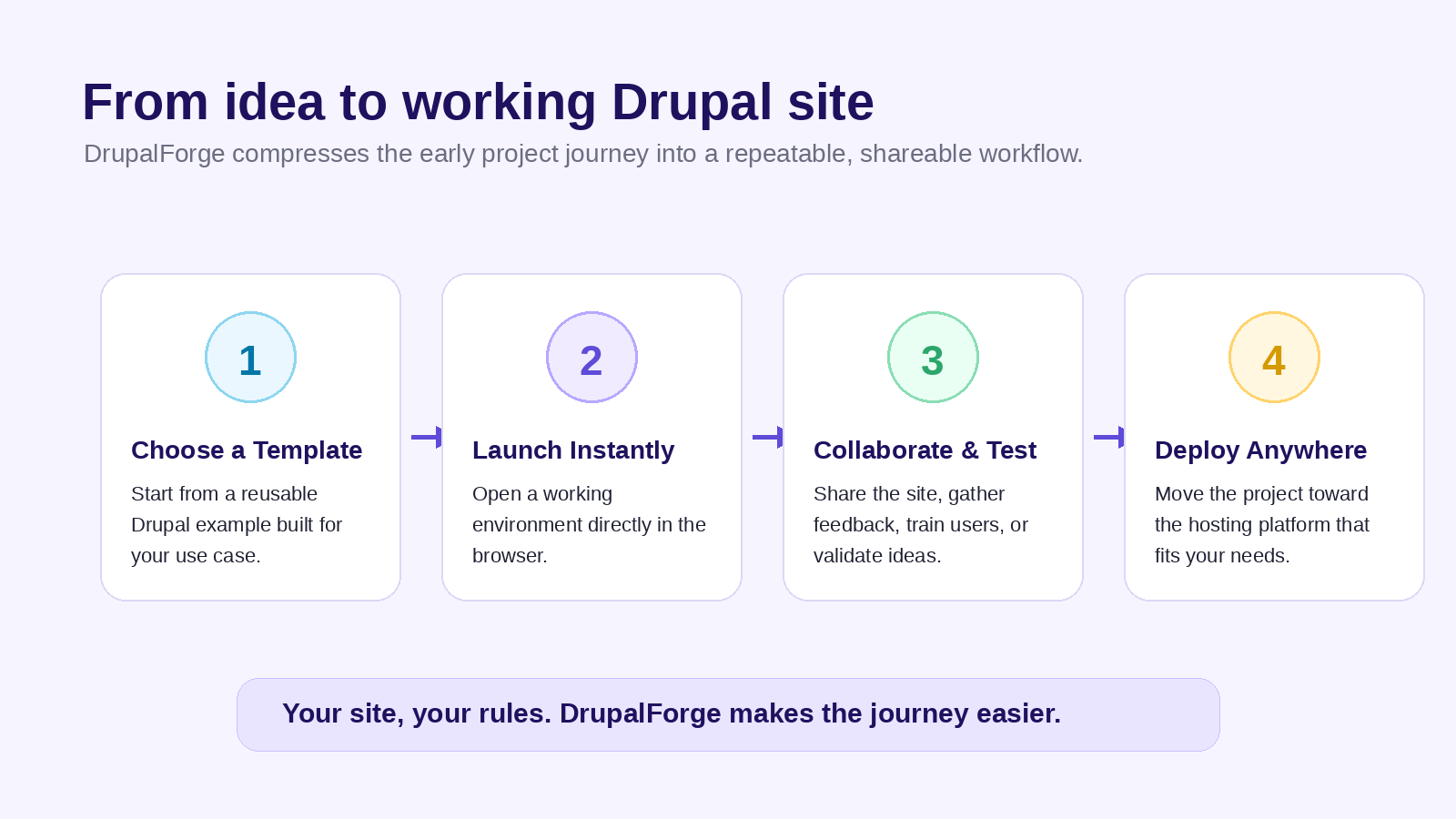
Getting started with DrupalForge is intentionally simple. Users can visit the DrupalForge website, choose a template, launch a site, and begin exploring. From there, they can save, share, clone, or adapt their environment depending on the use case.
Step | Action |
1. Visit DrupalForge | |
2. Choose a template | Select a starting point that fits the project, demo, training, or experiment. |
3. Launch the site | Start the environment directly from the browser. |
4. Collaborate and iterate | Share the environment with teammates, students, clients, or stakeholders. |
5. Deploy when ready | Move toward the preferred production hosting path when the project is ready. |
Conclusion
DrupalForge reduces one of the biggest barriers to Drupal adoption: the effort required to begin. By combining instant environments, reusable templates, browser-based access, and deployment freedom, it gives developers, agencies, educators, and organizations a faster way to experience what Drupal can do.
For developers, it is a safer and cheaper place to learn and experiment. For agencies, it is a stronger way to demonstrate value. For trainers, it creates consistent learning environments. For end users and organizations, it provides a low-friction path from exploration to implementation.
Most importantly, DrupalForge reinforces a principle that is deeply aligned with the Drupal community: open tools become more powerful when they are easier for more people to use. By making Drupal faster to launch, easier to share, and simpler to explore, DrupalForge helps more people move from interest to action.