How to Learn Drupal in 2026: Skip the Setup Hell
Why Your Development Environment Is the Real Bottleneck
🎧 Listen & Watch
Prefer to absorb this information on the go?
- Watch: How to Learn Modern Drupal Without Getting Stuck in Setup and DevOps – A visual breakdown of why the traditional learning path fails.
- Listen: The Right Way to Learn Modern Drupal in 2026 – A deep dive discussion on overcoming the "Desert of Despair."
Most people don’t fail at learning Drupal because the framework is too hard. They fail because they never actually get to the "learning" phase.
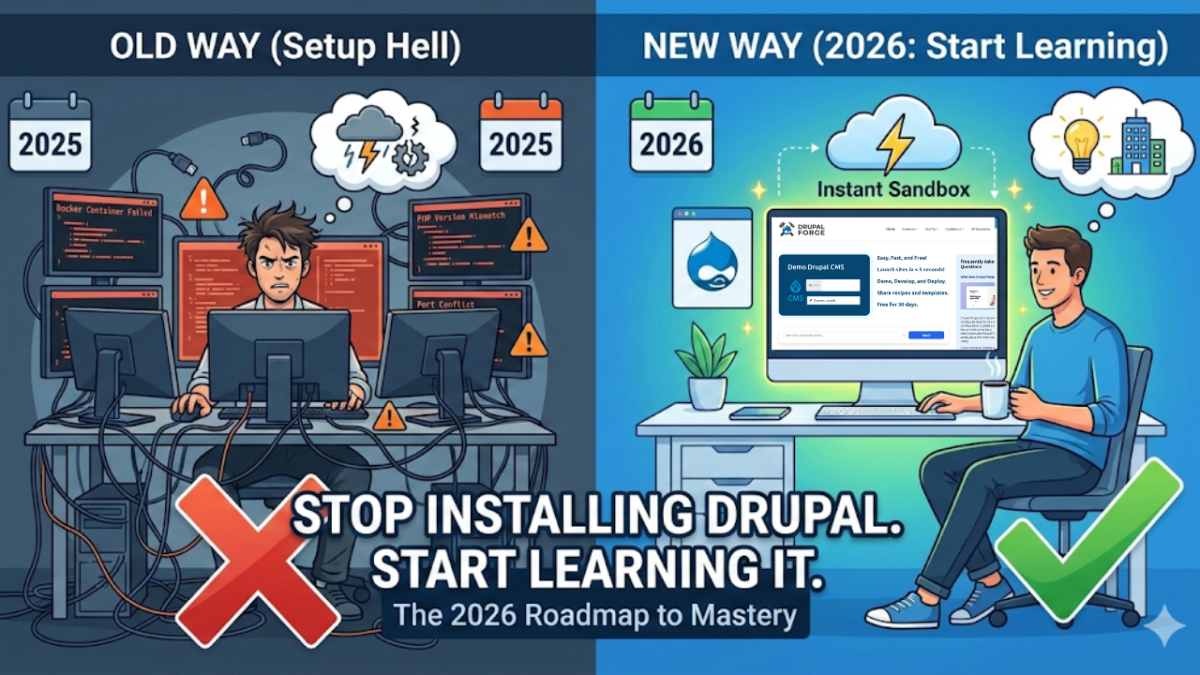
Instead, the journey typically begins in "setup hell": installing Docker, configuring DDEV, resolving PHP version mismatches, and fighting OS-specific permissions. Beginners spend days troubleshooting their local environment before they ever create a single content type.
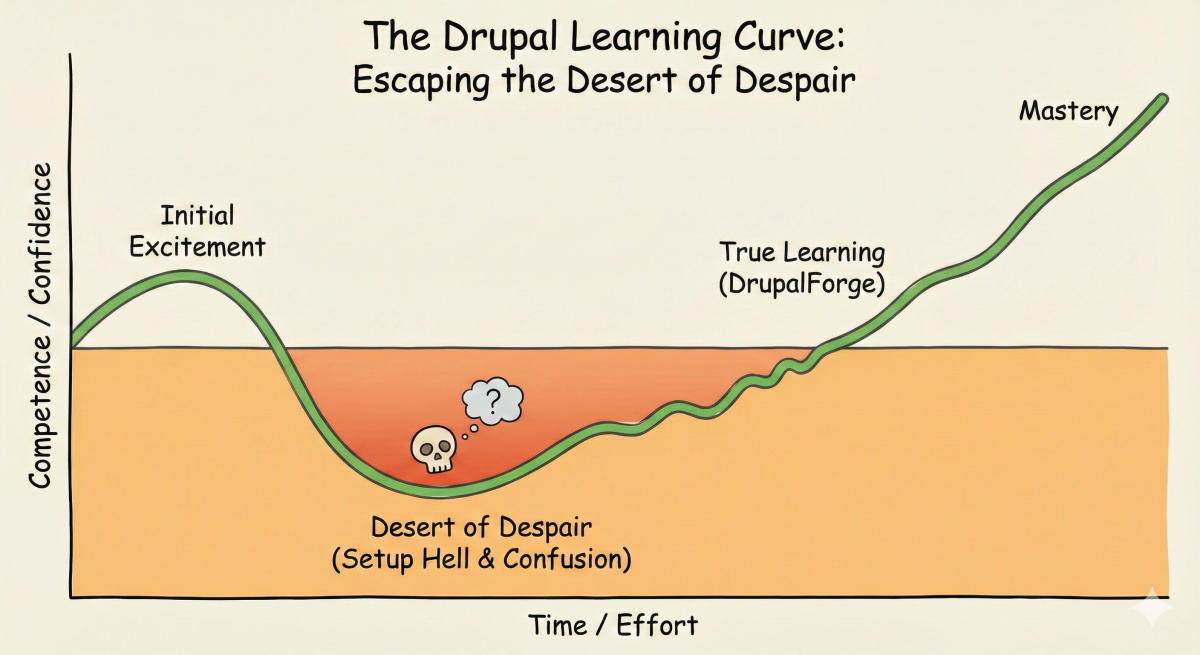
This friction leads directly to the "Desert of Despair". You know just enough to be confused, but not enough to move forward, leading many to quit under the false assumption that Drupal itself is the problem.
It isn’t.
Drupal is a content management framework, not a simple website builder like Squarespace or Wix. The fundamental mistake most learners make is trying to master DevOps and infrastructure before understanding Drupal's actual architecture.
4 Truths About Learning Modern Drupal
1. You Are Likely Learning DevOps, Not Drupal
If you are spending hours configuring local environments, you are learning server management, not Drupal. While skills like managing Docker containers and troubleshooting database connections are valuable, they are not prerequisites for learning Drupal's core concepts like content modeling or views.
Effective learning requires immediate access to a working site. When learners conflate environment troubleshooting with Drupal learning, they develop a mental model that Drupal is impossibly complex.
2. Drupal is a Framework, Not a Finished House
A common misconception is treating Drupal like a finished product. Drupal provides you with industrial-strength building materials—beams, bricks, and glass—but you must be the architect.
- The Problem: Learners expect a "move-in ready" house.
- The Reality: Drupal gives you the potential to build a skyscraper, but requires you to understand the engineering (entities, fields, views) first.
- The Fix: You need a template-based environment that demonstrates how these "building materials" fit together in a real scenario.
3. Fear of Breaking Things Blocks Progress
Learning requires a "safe" environment where mistakes cost nothing. In a permanent local environment, breaking a configuration might mean hours of repair. This creates anxiety, causing learners to stick to safe, shallow tutorials rather than experimenting.
To truly learn, you need a disposable environment. When you can destroy and recreate a site in seconds, you are free to break configurations intentionally to see how the framework behaves.
4. Configuration Must Be Treated as Code
Modern Drupal learning demands an understanding of the separation between content, configuration, and code. A common mistake is treating configuration (views, fields, site settings) like content.
- The Mistake: Making changes directly in a production database without exporting them.
- The Consequence: This leads to configuration drift, deployment failures, and broken sites.
- The Solution: You must learn the workflow of exporting configuration to code and managing it via version control.
The Solution: Why You Should Use DrupalForge.org
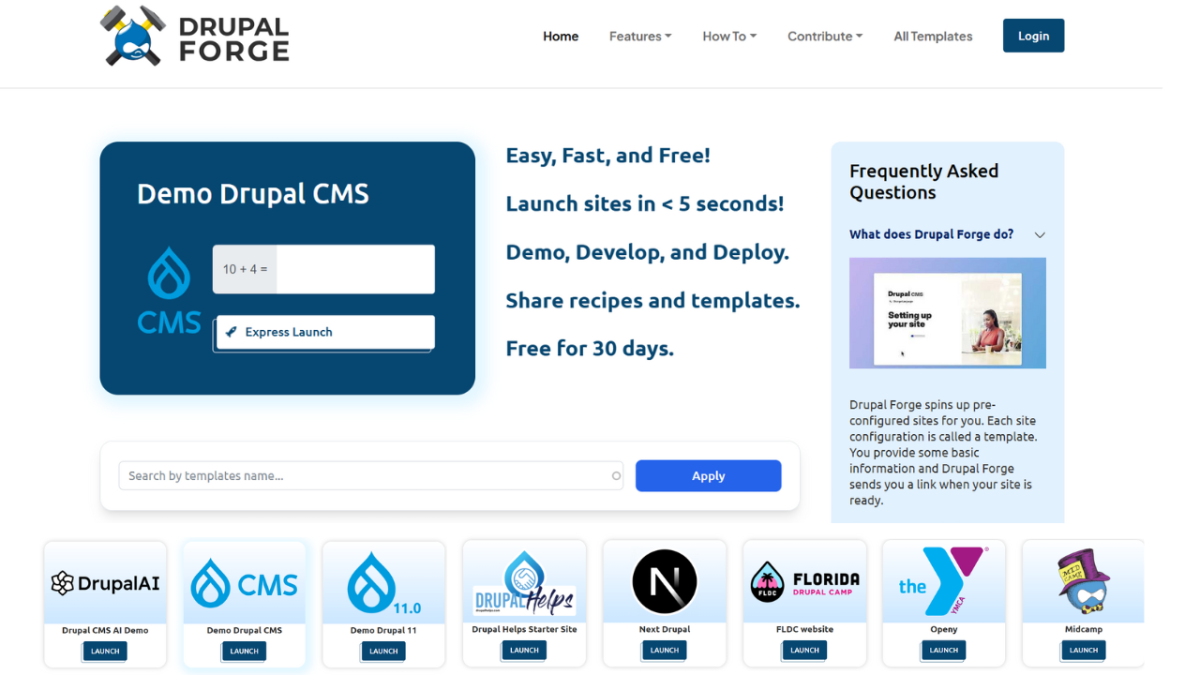
If you aren't using DrupalForge.org, you are likely doing it wrong. DrupalForge solves the infrastructure bottleneck by providing:
- Instant Access: Get a working Drupal site in under 5 seconds—no Docker or CLI required.
- Real Templates: Choose from over 20 pre-configured templates that include realistic content models and best-practice configurations.
- Disposable Sandboxes: Sites are designed to be broken and reset, encouraging the experimentation necessary for deep learning.
- Developer Toolchain: Access a full browser-based IDE with VS Code, Composer, and Drush without installing anything locally.
Quick Answers: Drupal Learning
Why is Drupal so hard to learn for beginners? Drupal is perceived as hard because most beginners are forced to manage complex server infrastructure (DevOps) before they start learning the application itself. This setup friction is often mistaken for Drupal's complexity.
Do I need to install Docker to learn Drupal? No. While Docker is standard for professional local development, using it to learn Drupal puts the "cart before the horse". It is more effective to use a cloud-based sandbox like DrupalForge to master the CMS concepts first.
What is the best way to practice Drupal site building? The best practice is to use "disposable" environments where you can experiment aggressively. Use template-based sites that already have content types and views configured, so you can reverse-engineer how they work rather than starting from a blank screen.
Final Thought: Is Your Environment Teaching You?
Before you start your next tutorial, ask yourself: Is my environment teaching me Drupal, or is it teaching me how to be a sysadmin?
If you are spending more time on terminal commands than on content modeling, it’s time to switch tools. Stop installing. Start learning.
Try DrupalForge.org for Free
Research Source: Perplexity.ai - Learning Drupal in 2026 Analysis